Guide · visiting Cambridge · England
Is Cambridge worth visiting? What it is known for, and how to see it
A university that has been teaching since 1209, a chapel roof nobody has matched in five hundred years, and a river that runs along the back of it all. Cambridge is 49 minutes from King's Cross, which means the real question is not whether to come. It is what you do with the day once you are here.
 Written and guided by Jordan Harrington, Cambridge punting guide since 2021
The short answer
Yes. Cambridge is known for its university, founded in 1209 and the second-oldest in the English-speaking world, for 31 colleges and 126 Nobel Prizes, for King's College Chapel and its record-holding fan vault, for the free Fitzwilliam Museum, and for punting on the River Cam. It is a 49-minute direct train from London King's Cross, and the whole of it fits in a day. The one thing you cannot do on foot is see the College Backs, the face of the colleges that only ever pointed at the river.
What is Cambridge best known for?
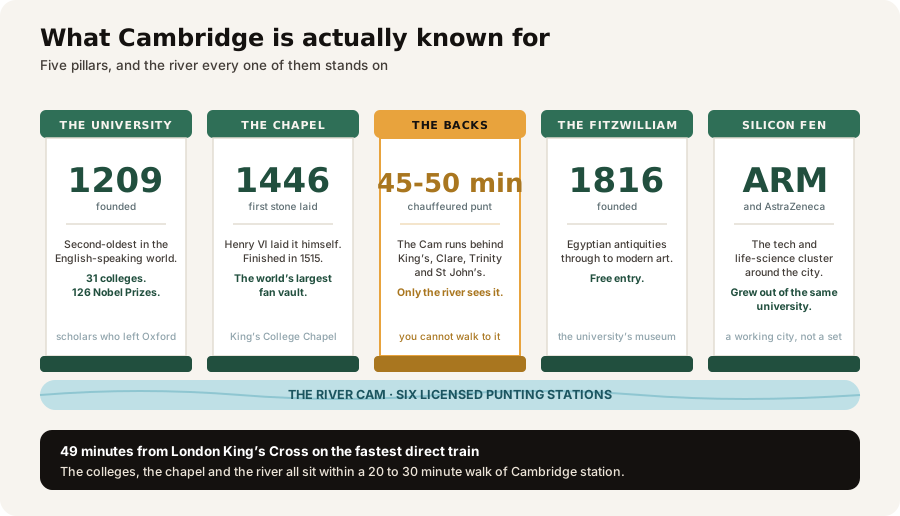
The University of Cambridge, founded in 1209 and the second-oldest university in the English-speaking world. Everything else people associate with the city grew out of it: 31 colleges, 126 Nobel Prizes, King's College Chapel and its fan vault, the Fitzwilliam Museum, punting on the River Cam, and Silicon Fen, the technology cluster that gave the world ARM and hosts AstraZeneca.
The founding story is a small joke that never wore off. Scholars left Oxford after a dispute, walked east, and started again on the Cam. Eight hundred years later the two universities are still measured against each other, and Cambridge is the one that ended up with a river running through the middle of its best architecture.
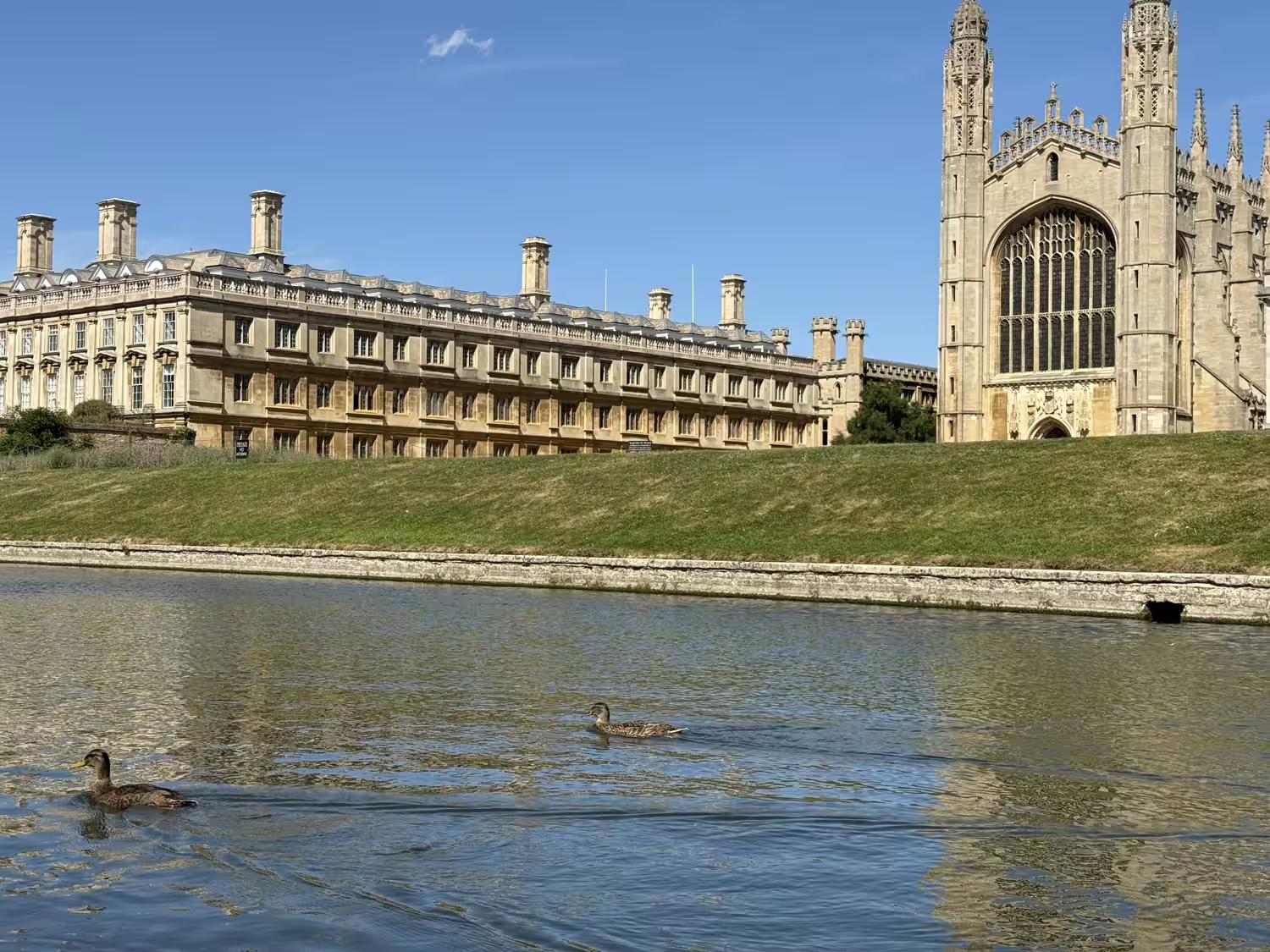
King's College Chapel is the single image most people carry. Henry VI laid its first stone himself in July 1446, planning it as a Cambridge counterpart to Eton. It took until 1515 to finish, and the fan vault raised over the last three years of that build has never been beaten for size anywhere in the world. From the water you get the length of it in one look, which is a different thing entirely from standing under it.
Then there are the bridges, and they are the part visitors ask me about most. The Bridge of Sighs at St John's went up in 1831, designed by Henry Hutchinson, and it is covered, which is why it photographs the way it does. The Mathematical Bridge at Queens' dates from 1749. Half the people on my punt arrive believing Isaac Newton built it without a single bolt and that students later took it apart and could not reassemble it. Newton died in 1727. Queens' own historians have been patiently correcting this for decades, and the bridge always used iron fastenings. I tell people anyway, because a good myth is worth knowing you have been told.
What visitors underrate is that Cambridge is a working city rather than a preserved one. The same university that produced the Nobel list also seeded the cluster around it. That is the texture of the place: undergraduates, tourists and biotech staff on the same pavement.
Is Cambridge worth visiting?
Yes, and the reason is compression. Cambridge holds eight centuries of one of the most famous universities on earth inside a centre you can cross on foot in twenty minutes, 49 minutes from London, with the best museum in it free to enter. Very few places give you that much for that little effort.
I should be straight about my angle here. I guide punts on this river, so of course I think you should come. What I can offer is the honest shape of the visit rather than a sales pitch.
Cambridge is small. That is the whole case for it, and it is also the thing people get wrong. They arrive expecting a city and find a town with a university wrapped around it, then feel short-changed because they had budgeted three days. Budget one and it is close to perfect. The colleges, the chapel, the Fitzwilliam, the market and the river all sit within a few hundred metres of each other.
The honest reasons not to come: if you want nightlife, big shopping, or a museum district on the scale of London, this is not that. If you want to walk into every college whenever you feel like it, term time, exams and college events will disappoint you. Access varies by college and by day, which is why we point you at each college's own site rather than printing a rule that will be wrong by the time you read it.
The reasons to come are simpler. It is genuinely old, genuinely beautiful, genuinely still in use, and it is close. Our things to do in Cambridge post covers the wider list once you are here.
Cambridge or Oxford: which should you visit?
If you can only pick one and you want the picture in your head of colleges rising out of a river, pick Cambridge, because the Cam physically runs behind King's, Clare, Trinity and St John's along the stretch called the Backs and Oxford's rivers do not. If you want a larger city with more colleges and more going on around them, pick Oxford. "Prettier" is a matter of taste and anybody stating it as a fact is guessing.
Let me separate the opinion from the geography, because the geography is the part that actually decides your day.
Oxford is older on paper: there is evidence of teaching from 1096, against Cambridge's 1209. It is bigger, with 36 colleges plus further halls and societies to Cambridge's 31, and a larger population. Punting happens in both cities, so that is not a point of difference on its own. Oxford punts run on the Cherwell and the Isis.
The difference is where the water is. In Cambridge the river passes directly along the back of the historic colleges, so the facades and gardens the colleges designed to be looked at from a boat are still there, being looked at from a boat. In Oxford the punting rivers do not run immediately behind the central colleges in that way, and the trip is more parkland and riverside than college. Neither is better. They are different products, and only one of them is the postcard people mean when they say "Cambridge".
| For a visitor | Cambridge | Oxford |
|---|---|---|
| University from | 1209 | Teaching evidenced from 1096 |
| Colleges | 31 | 36, plus further halls and societies |
| Fastest direct train from London | 49 min from King's Cross | About 45 min from Paddington |
| Population (2021 Census) | About 145,700 | About 162,000 |
| Punting river | The Cam, directly behind the colleges | The Cherwell and the Isis, not behind the central colleges |
| The signature building | King's College Chapel, 1446 to 1515, world's largest fan vault | Its own famous set, on foot rather than from the water |
| Feels like | A town the university grew through | A city with a university in it |
Sources: University of Cambridge, University of Oxford, ONS Census 2021, and current operator rail timetables.
The tiebreaker most people actually use: which one is easier to get to from where you are sleeping. If that is King's Cross or anywhere on the Thameslink line, the answer picks itself.
Is Cambridge a good day trip from London?
It is one of the best in England. The fastest direct Great Northern train from King's Cross runs it in 49 minutes, with several direct services an hour, and Greater Anglia does Liverpool Street to Cambridge in about 1 hour 12 at its quickest. Cambridge station is roughly 1.5 miles from King's College, about a 20 to 30 minute walk, or a short bus.
People search for what sits within a two-hour train ride of London and then plan as if Cambridge is at the edge of that circle. It is nowhere near it. Under an hour each way means you can leave London after breakfast, have a full unhurried day, and still be back for dinner without watching the clock from three in the afternoon. If you would rather not plan the logistics at all, a guided coach day trip from London that pairs Cambridge with Oxford in a single day can be checked here, though it is a separate booking from a punt on the Cam.
The walk from the station is the one thing worth knowing in advance. It is pleasant and flat, but it is not two minutes, and on a hot day with a booked punt at the other end it is the bit that catches people out. Either allow half an hour or take the bus. Once you are in the centre, everything else is walkable, including all six licensed punting stations. Our guide to where to punt maps them.
One practical note from the river: the last train back is not the constraint. Light is. Punting after dusk in the shoulder seasons is a different experience, and in winter the useful daylight is gone by mid-afternoon. If your day trip is between roughly November and February, put the punt earlier in the plan than feels necessary. More on that in the best time of year to punt.
Book your punt
Ready to get on the River Cam?
Shared, private and student-guided punts run daily along the College Backs. See the live price and free-cancellation terms on the operator's official listing before you pay.
Check live availability & prices →4.7 · 1,521 reviews · free cancellation up to 24 hours
What is the best way to see Cambridge?
Walk the centre, then punt the College Backs. Not because a punt is charming, though it is, but because of how the colleges were built. King's, Clare, Trinity and St John's face the river, and the side of them designed to be admired, plus the Bridge of Sighs and the Mathematical Bridge, cannot be reached on foot. A chauffeured punt covers the whole stretch in about 45 to 50 minutes.
This is the part where I have something to say that a general travel guide cannot. I have poled this stretch since 2021, and I watch the same thing happen most days. People spend the morning on King's Parade photographing the front of King's College, which is a gate and a wall. Then they get on the water and see the chapel from behind, standing out of its own lawn, and there is a pause. That is the building. The other side was the entrance.
The Backs run past King's, Clare, Trinity and St John's, under the Bridge of Sighs and the Mathematical Bridge. You cannot walk those lawns. You cannot photograph that angle from a street, because there is no street. The colleges put their backs to the town and their faces to the Cam eight hundred years ago, and nobody has moved them since.
So the honest hierarchy for a first visit is: the centre on foot, then the river. Not the river instead of the centre. Both, in that order, because the punt makes sense of what you have just walked around.
Some practical honesty about the format. Chauffeured means somebody else poles and talks; self-hire means you do, and steering a punt is harder than the people gliding past make it look. For a first visit, take the chauffeured version and spend the 45 minutes looking up rather than fighting a pole. Our comparison page lays the formats out side by side, and the prices guide covers what each one costs. Prices move with season and demand, so we do not print them as fact: check the live price on the official listing before you pay.
The route itself, college by college, is in our College Backs guide.
How long do you need in Cambridge?
One full day. That covers the centre on foot, one college or King's College Chapel, a punt along the Backs, and the Fitzwilliam, without running. Half a day works if you cut to the centre and the river. Two days is only worth it if you want Grantchester, the Botanic Garden and the museums as well.
Here is how a single day actually falls out, based on watching several thousand visitors arrange one badly and then well.
| Time | Do this | Why then |
|---|---|---|
| Arrive by 10:00 | Train from King's Cross, walk or bus in from the station | 49 minutes on the fastest direct service, then 20 to 30 minutes on foot |
| 10:30 to 12:00 | The centre on foot: King's Parade, the market, the college fronts | Gets you oriented before the river makes sense of it |
| 12:00 to 13:00 | Lunch, and pick up a college or the chapel if it is open that day | College access shifts with term, exams and events. Check the college's own site for your date |
| 13:00 to 14:00 | Punt the College Backs, chauffeured | About 45 to 50 minutes, and the only way to see the river face of King's, Clare, Trinity and St John's |
| 14:30 to 16:00 | The Fitzwilliam Museum | Free entry, Egyptian antiquities through to modern art, and indoors if the weather turns |
| 16:00 onward | Wander, or walk the Backs footpath, or head back | The day is already complete. Anything past here is a bonus |
Opening times and college access change through the year. Check each site for your date rather than relying on any published timetable, including this one.
Two things about that plan. First, it is deliberately not full. Cambridge punishes over-scheduling because the pleasure of it is unhurried. Second, if you only have half a day, drop the museum and the college, keep the walk and the punt, and you will still have seen the city properly.
If you have a second day, that is when Grantchester becomes an option, upriver through meadows rather than colleges, and a completely different kind of afternoon.
What does a day in Cambridge cost, and what is free?
More of it is free than people expect. The Fitzwilliam Museum charges nothing, the market costs nothing to walk through, and the footpath along the Backs is open to anyone. The paid items are short: college and chapel entry, the tower climb, the Botanic Garden, and the punt.
This is the part that surprises visitors who have just come from London, where a day of sights adds up fast. In Cambridge the two biggest attractions, the architecture and the river frontage, are things you look at rather than things you buy a ticket for. You can have a full, satisfying day here and spend money on precisely two things: lunch and a boat.
What follows is a planning table, not a price list. Punting is priced dynamically, college access shifts with term and events, and any fixed figure printed on a guide page ages badly, so treat the ranges as shapes and check the live number before you pay.
| What | Free or paid | The planning note |
|---|---|---|
| Walking the centre and the Backs footpath | Free | King's Parade, the college fronts, and the river from the bank. Allow a couple of hours to do it slowly |
| Fitzwilliam Museum | Free entry | Egyptian antiquities through to modern art. Opening hours shift, so check the museum's own page for your date |
| Cambridge market | Free to browse | Centuries old, and still the cheapest decent lunch in the centre |
| King's College Chapel | Paid college entry | Access varies with term, exams and ceremonial days. Check the college's own site rather than any printed figure |
| Great St Mary's tower climb | Paid | The rooftop view over King's and the centre. Worth it on a clear day |
| Botanic Garden | Paid, a small charge | Forty acres on the edge of the centre. Better as a second-day option than a squeezed hour |
| Shared chauffeured punt | Paid per person | Typically from around £16 to £28 for about 45 to 50 minutes. The cheapest guided way onto the water |
| Private punt | Paid per punt | One fee covers the boat, so the cost per head falls as you fill it. The choice for families and occasions |
| Self-hire punt | Paid per hour, per boat | A deposit is held at check-in, usually a card hold or a photo ID. You supply the steering |
Price shapes come from our Cambridge punting prices guide, which uses operators' typical listed ranges rather than fixed quotes. Everything here moves with the season and the date.
The one line worth padding is lunch, because Cambridge in July fills its restaurants with graduation parties. If you are here in the first week of July, book a table as seriously as you book a boat.
What can you see from the water that you cannot see on foot?
The river face of the colleges, which is the side they were designed to be admired from. From the street you get gates, walls and the fronts. From the water you get King's College Chapel standing over its own lawn, the underside of the Bridge of Sighs, and the Mathematical Bridge from below.
People treat this as a sales line, so let me put it as geometry instead. The colleges along the Backs own the land on both sides of the Cam. Their lawns are private, their bridges are private, and there is no public street on that side because the river is the street. Everything you see from a punt is on land you cannot walk on and from an angle no pavement offers.
That is why the same building can feel like two different buildings in one afternoon. The front of King's is a gate and a screen wall on a busy road. The back of it is a chapel rising clean out of grass with nothing in front of it. Most people go quiet at that point, which is the only reliable review I can offer after five seasons of watching it happen.
| What you came to see | From the street | From a punt |
|---|---|---|
| King's College Chapel | The front, from King's Parade, behind a gate and a screen wall | The full length of it standing over the back lawn, with nothing between you and the stone |
| The Bridge of Sighs | Only at a distance, and only from inside St John's when the college is open | Head-on as you approach, then from directly underneath |
| The Mathematical Bridge | Over railings from the Silver Street bridge, at eye level and usually in a crowd | Low against the water, then from beneath, which is where the timber design makes sense |
| Clare Bridge, 1639 to 1640 | Sometimes, when the college path is open to visitors | From below, all three arches and the stone balls along the parapet |
| The college back lawns | Across the water from the Backs footpath, at a distance | Alongside them, at the level they slope down to |
| Trinity and the Wren Library stretch | Not from any public street | Straight along the riverbank as you pass |
| The whole run in one go | Broken up by roads, gates and opening hours | Around seven colleges and nine bridges in 45 to 50 continuous minutes |
Street-side and footpath access to college grounds and bridges changes with term, exams and college events, so check the individual college for your date. The river itself has no such closures.
The college-by-college version of the route, with what to look for at each stop, is in our College Backs guide.
What do visitors get wrong about a day in Cambridge?
Almost always one of three things: they underestimate the walk in from the station, they book the river for the busiest hour of the day, or they plan the day as a checklist. None of those ruins a trip. Each one quietly takes an hour out of it, and an hour is a lot in a one-day city.
I have guided here since 2021, which mostly means I have watched several thousand people arrive slightly out of breath. The pattern is consistent enough that I can usually tell which mistake someone made before they sit down.
Here they are, with the fix in each case. None of them require you to spend more money, and most of them just require deciding something the night before rather than on the pavement.
| The mistake | What it costs you | What to do instead |
|---|---|---|
| Treating the station as walking distance in the London sense | Roughly 1.5 miles and 20 to 30 minutes each way, twice, and often a missed slot | Allow half an hour, or take the bus and keep the walk for the way back |
| Booking the punt for the middle of the day in summer | The busiest block on the water is reliably noon to 4pm | Take an early slot or one after 4pm. The route is identical and the river is not |
| Leaving a summer weekend punt to a walk-up queue | The peak is Saturday and Sunday afternoons from May to September | Book a week or two ahead. Viator punting bookings average around ten days out |
| Buying from someone with a laminated card on King's Parade | Neither King's Parade nor Market Square is a licensed punting station | Buy at one of the six licensed stations, or online before you arrive |
| Assuming every college is open | Exam-period closures. Queens' listed 19 April to 4 July for 2026 | Check the college you actually care about, on its own site, for your date |
| Planning a winter punt for late afternoon | Around the solstice the light is gone by roughly 3:48pm | Put the river before lunch in winter and the indoor things after it |
| Scheduling six colleges into one day | You tick everything and enjoy none of it | Two or three things done slowly, and half an hour sitting by the water |
Booking averages and the licensed-station rule are covered in our booking guide and stations guide. Crowd hours are my own observation from the water.
Who is Cambridge right for, and who should skip it?
Cambridge is close to unbeatable for a day of old architecture, one great museum and an hour on the water. It is a poor choice for nightlife, big shopping, or anyone who wants to walk into every college on a whim. Knowing which of those you are saves the disappointment.
I would rather say this plainly than pretend the city suits everybody. The things that make Cambridge excellent, its size, its age and the fact that it is still a working university rather than a museum of one, are exactly the things that frustrate a certain kind of visitor.
| If this is you | Cambridge is | The honest reason |
|---|---|---|
| First time in England with one spare day | An easy yes | 49 minutes from King's Cross, and the whole centre crosses on foot in twenty minutes |
| Here for history and architecture | A yes | A university running since 1209, 31 colleges, and a chapel built between 1446 and 1515 |
| Travelling with children | A yes, with a plan | Market, Botanic Garden and a chauffeured punt. The chauffeured boats carry no fixed minimum age |
| Chasing photographs | A yes, in October and November | Low sun, autumn colour on the Backs, and the summer boats gone |
| After nightlife or serious shopping | Not this trip | It is a town with a university around it, not a night-out city |
| Hoping to wander into any college at any time | A frustration | Access varies by college, by term and by exam period, with no single university-wide rule |
| Expecting a museum district on London's scale | No | The Fitzwilliam is world class, but it is one museum, not a quarter of them |
| Holding three days with nothing else booked | Too long, unless you spread out | Budget one day for the city, then add Grantchester, the Botanic Garden and the smaller museums |
Planning guidance rather than a rule book. College access, opening hours and operator policies change through the year, so confirm anything you are relying on before you travel.
If you fall in the last row, the upriver trip to Grantchester is the natural second day: meadows rather than colleges, and roughly two to three hours of punting each way, which is why it is a self-hire proposition rather than a chauffeured one.
Visiting Cambridge: FAQ
What is Cambridge, England best known for?
Its university, founded in 1209, the second-oldest in the English-speaking world and the third-oldest in continuous operation anywhere. Around that sit 31 colleges, 126 Nobel Prizes, King's College Chapel with the world's largest fan vault, the Fitzwilliam Museum, punting on the River Cam past the College Backs, and Silicon Fen, the technology and life-science cluster that produced ARM and hosts AstraZeneca.
Is Cambridge, England worth visiting?
Yes, and it is unusually easy to justify. The fastest direct train from London King's Cross takes 49 minutes, almost everything a visitor comes for sits inside a small walkable centre, and the Fitzwilliam Museum is free to enter. Cambridge rewards a day rather than a week, which is exactly why it works.
Which is prettier, Cambridge or Oxford?
That is opinion, not fact, and anyone who tells you otherwise is selling something. The honest geographic difference is this: in Cambridge the River Cam runs directly behind the historic colleges along the stretch called the Backs, so King's, Clare, Trinity and St John's present their gardens and their best facades to the water. Oxford's punting rivers, the Cherwell and the Isis, do not run behind the central colleges the same way. If your idea of pretty is colleges reflected in a river, Cambridge is built for it. Oxford is the bigger city with more colleges, 36 plus further halls and societies against Cambridge's 31.
Is Cambridge a good day trip from London?
It is one of the easiest in England. The fastest direct Great Northern service from King's Cross takes 49 minutes, with several direct trains an hour. Greater Anglia runs from Liverpool Street in about 1 hour 12 minutes at its quickest. Cambridge station sits roughly 1.5 miles from King's College, about a 20 to 30 minute walk, or a short bus ride.
What is the best way to see Cambridge?
Walk the centre, then punt the College Backs. The reason is geometry, not sales: the colleges were built facing the river, so the side of King's, Clare, Trinity and St John's that architects designed to be admired, along with the Bridge of Sighs and the Mathematical Bridge, can only be seen from the water. A chauffeured punt covers that stretch in about 45 to 50 minutes with a guide doing the poling.
How long do you need in Cambridge?
One full day covers the city properly: the centre on foot, one college or King's College Chapel, a punt along the Backs, and the Fitzwilliam. Half a day is enough for the centre and a punt if you are tight. Two days lets you add Grantchester, the Botanic Garden and the museums without rushing.
Do you have to pay to get into Cambridge colleges?
Some charge and some do not, and access varies with term time, exams and events. King's College Chapel charges visitor admission. The Fitzwilliam Museum is free. Because college opening and prices change through the year, check the individual college website for the day you are going rather than trusting a figure printed anywhere else.
Is Cambridge within a 2 hour train ride from London?
Comfortably. The fastest direct train from King's Cross is 49 minutes, so Cambridge sits at well under half of a two-hour radius even allowing for a slower service. That leaves the bulk of your day in the city rather than on a train.
See the side of Cambridge you cannot walk to
Start with the most-booked option: a shared chauffeured punt along the Backs, past King's, the Bridge of Sighs and the Mathematical Bridge, with the live price and cancellation terms shown before you pay.